Turkey tail mushroom (Trametes versicolor) has been used in traditional Asian medicine for centuries, but modern researchers are now uncovering a specific reason why it may support human health: its ability to act as a prebiotic, feeding and shaping the communities of beneficial bacteria that live in your gut. If you’ve heard the phrase “gut health” and wondered whether functional mushrooms could play a role, turkey tail is the species most worth understanding.
What Makes Turkey Tail Different
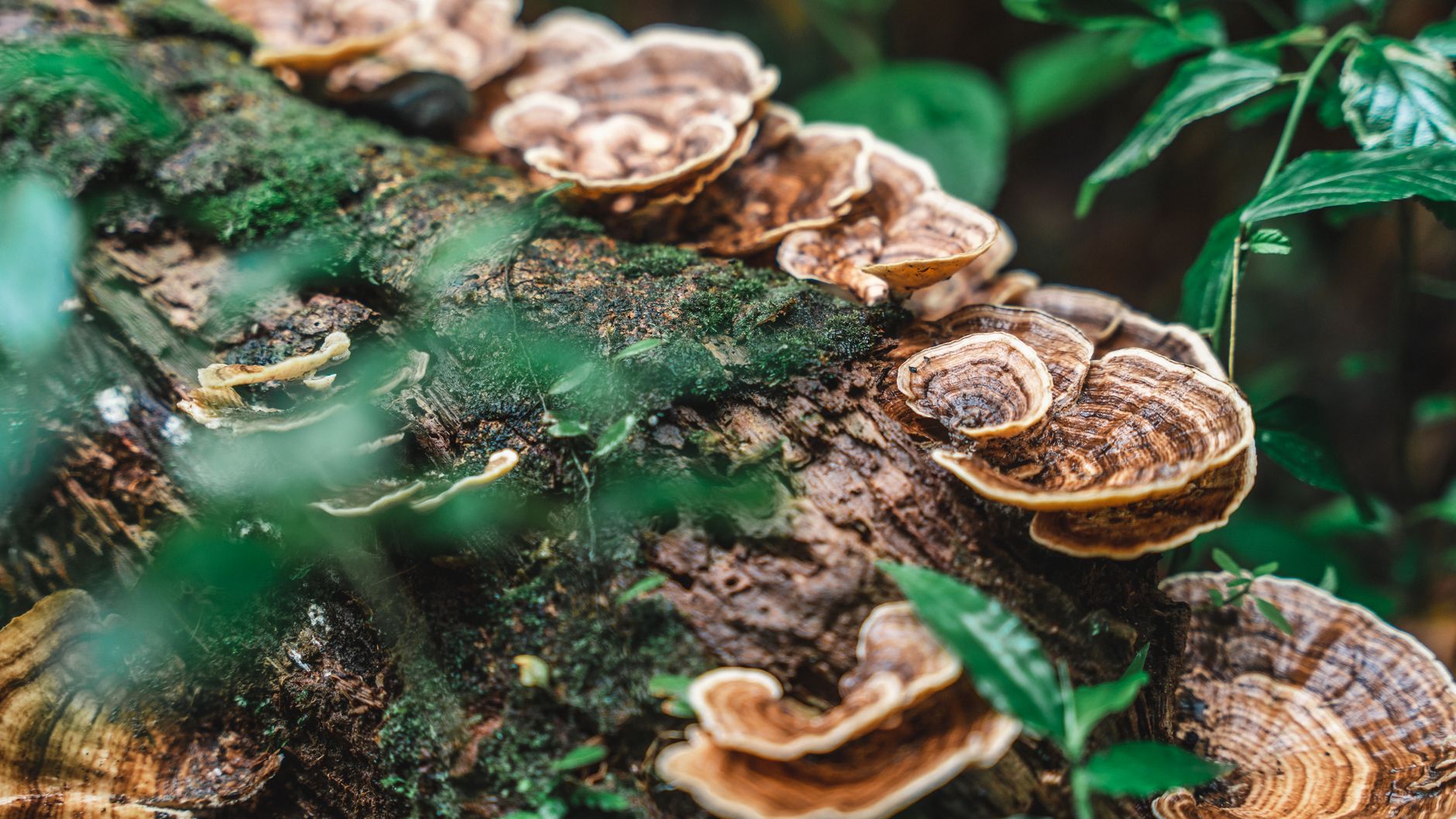
Turkey tail is named for its concentric rings of color, which resemble the fanned tail feathers of a wild turkey. Unlike some functional mushrooms that are too tough or bitter to eat directly, turkey tail has been prepared as a tea or decoction for generations in China, Japan, and Korea. It grows abundantly on dead hardwood trees across North America, Europe, and Asia, making it one of the most accessible medicinal fungi in the world.
The two primary bioactive compounds isolated from turkey tail are polysaccharopeptide (PSP) and polysaccharide-K (PSK, also known as krestin). Both belong to a class of compounds called beta-glucans: long-chain polysaccharides that the human body cannot fully digest but that gut bacteria can ferment and utilize. To understand why this matters, it helps to know a bit about how beta-glucans work in functional mushrooms more broadly.
Turkey Tail as a Prebiotic: The Clinical Evidence
A prebiotic is a substance that selectively feeds beneficial gut bacteria without being absorbed by the host. Fiber is the most well-known example; certain mushroom polysaccharides appear to function similarly. The clinical evidence for turkey tail specifically is more developed than for most other functional mushrooms.
A randomized clinical trial published in Gut Microbes examined the effects of PSP from Trametes versicolor on the gut microbiome of healthy volunteers.[1] Twenty-four participants were assigned to receive PSP, amoxicillin (an antibiotic), or no treatment. The PSP group showed clear and consistent microbiome changes that aligned with prebiotic activity, including shifts in bacterial composition that were distinct from the antibiotic group. The antibiotic, by contrast, caused substantial disruption, including increases in potentially harmful bacteria, and recovery took weeks after treatment ended. The study, conducted at Harvard Medical School’s Beth Israel Deaconess Medical Center, provides some of the strongest direct clinical evidence that turkey tail’s PSP acts as a prebiotic in humans.
Complementing this, a 2025 review in NPJ Science of Food examined how bioactive components from edible and medicinal fungi, including polysaccharides from Trametes versicolor, modulate the gut microbiome.[2] The review highlighted that fungal polysaccharides such as beta-glucans can enhance intestinal barrier function, increase production of short-chain fatty acids (SCFAs), and help inhibit pathogen colonization. These mechanisms connect turkey tail’s prebiotic effects to broader metabolic and immune outcomes.
Short-Chain Fatty Acids: Why Gut Fermentation Matters
When bacteria in your colon ferment prebiotic fibers, the primary byproducts are short-chain fatty acids (SCFAs), particularly butyrate, propionate, and acetate. Butyrate is the preferred energy source for colonocytes (the cells lining your colon), and it plays important roles in regulating inflammation and maintaining the intestinal barrier. Propionate is transported to the liver and influences glucose and lipid metabolism. Acetate enters the bloodstream and can influence appetite-regulating hormones.
The SCFA connection is why researchers are increasingly interested in functional mushrooms like turkey tail not just as direct immune modulators, but as upstream regulators of gut ecology that have downstream effects throughout the body. A gut with a diverse, well-fed microbial community produces more SCFAs; more SCFAs means a stronger barrier and a better-regulated immune system. Turkey tail’s prebiotic polysaccharides appear to support exactly this kind of environment.
PSK, PSP, and the Immune Connection
A 2016 review in the International Journal of Medicinal Mushrooms summarized the research on PSP from Trametes versicolor, noting its immunomodulatory effects alongside its prebiotic activity in the intestinal microbiome.[3] PSK, the related compound, has been approved as an adjunct cancer treatment in Japan for decades, largely based on its ability to stimulate immune activity. While PSK and PSP are structurally distinct, both appear to interact with immune receptors in the gut lining, including toll-like receptors (TLRs) that help the immune system distinguish between beneficial and harmful microorganisms.
The gut is home to roughly 70 percent of the body’s immune tissue. Supporting a healthy gut microbiome is therefore not just about digestion: it’s about immune readiness. Turkey tail’s dual action as both a prebiotic (feeding beneficial bacteria) and an immune modulator (directly stimulating immune receptors) makes it scientifically interesting in a way that few supplements can match.
What Turkey Tail Supplements Look Like
Turkey tail is available in several forms: dried whole mushroom powder, hot-water extracts, dual-extraction tinctures, and capsules. For prebiotic effects specifically, the polysaccharide content matters most, and this is best preserved through hot-water extraction, the same method used to brew traditional mushroom teas. Look for products that specify the extraction method and, ideally, provide third-party testing for beta-glucan content.
As with all functional mushrooms, dosing in research studies varies considerably. A 2014 randomized trial used a specific daily dose of PSP over an 8-week period; no general dosage recommendation applies to all individuals, and any supplementation should be discussed with a qualified healthcare provider. People who are immunocompromised, pregnant, or taking immunosuppressive medications should exercise particular caution and consult their doctor before adding turkey tail or any functional mushroom to their routine.
Whole Mushroom vs. Isolated Extracts
One ongoing debate in functional mushroom research is whether isolated extracts (like purified PSP or PSK) produce effects that differ from consuming the whole mushroom. Most published clinical trials use standardized extracts rather than whole powder, which makes it difficult to directly translate research findings to commercial products. However, whole-mushroom preparations contain a broader spectrum of polysaccharides, phenols, and other bioactives that may work synergistically. The research base for turkey tail, while smaller than for some pharmaceutical compounds, is stronger than for most functional food categories.
Who Is Turkey Tail Most Relevant For?
Based on available research, turkey tail as a prebiotic supplement may be most relevant for people who:
- Have recently completed a course of antibiotics and are looking to support microbiome recovery
- Are interested in immune support through gut-mediated pathways
- Want to increase dietary beta-glucan intake alongside other fiber sources
- Are exploring functional mushrooms and want the species with the strongest clinical evidence for gut health specifically
Turkey tail is generally regarded as safe and well-tolerated in healthy adults. Mild digestive symptoms (gas or bloating) are occasionally reported when starting any new prebiotic, as the microbiome adjusts to new fermentation substrates.
The Bottom Line
Turkey tail mushroom is not a trendy superfood without substance. It is, in fact, one of the few functional mushrooms with direct human clinical trial data showing prebiotic effects on the gut microbiome. The mechanisms are plausible, the evidence is reasonably consistent, and the traditional use history spans centuries. If gut health is a priority for you, turkey tail deserves a place in the conversation alongside more familiar prebiotic sources like inulin and resistant starch. As always, the best approach is to treat it as one component of a diverse, fiber-rich diet rather than a standalone fix.
References
- [1] Pallav K, et al. Effects of polysaccharopeptide from Trametes versicolor and amoxicillin on the gut microbiome of healthy volunteers: a randomized clinical trial. Gut Microbes. 2014;5(4):458-67. PMID: 25006989
- [2] Jin Y, et al. Application of edible fungi in gut microbiota regulation. NPJ Sci Food. 2025;10(1):24. PMID: 41422274
- [3] Wu JM, et al. Recent Advances and Challenges in Studies of Control of Cancer Stem Cells and the Gut Microbiome by the Trametes-Derived Polysaccharopeptide PSP. Int J Med Mushrooms. 2016;18(8):651-660. PMID: 27910783
This article is for informational purposes only and does not constitute medical advice. Always consult a qualified healthcare provider before starting any supplement.