Reishi (Ganoderma lucidum) and turkey tail (Trametes versicolor) are two of the most researched functional mushrooms in modern biomedical literature. Both have long histories of use in traditional East Asian medicine and have attracted growing scientific interest for their potential effects on immune function. While they share some overlapping mechanisms, they differ in their primary bioactive compounds, research depth, and the specific health areas where evidence is currently strongest. This article compares the two species across several key dimensions to help clarify where each may fit in a wellness context.
Background and Taxonomy
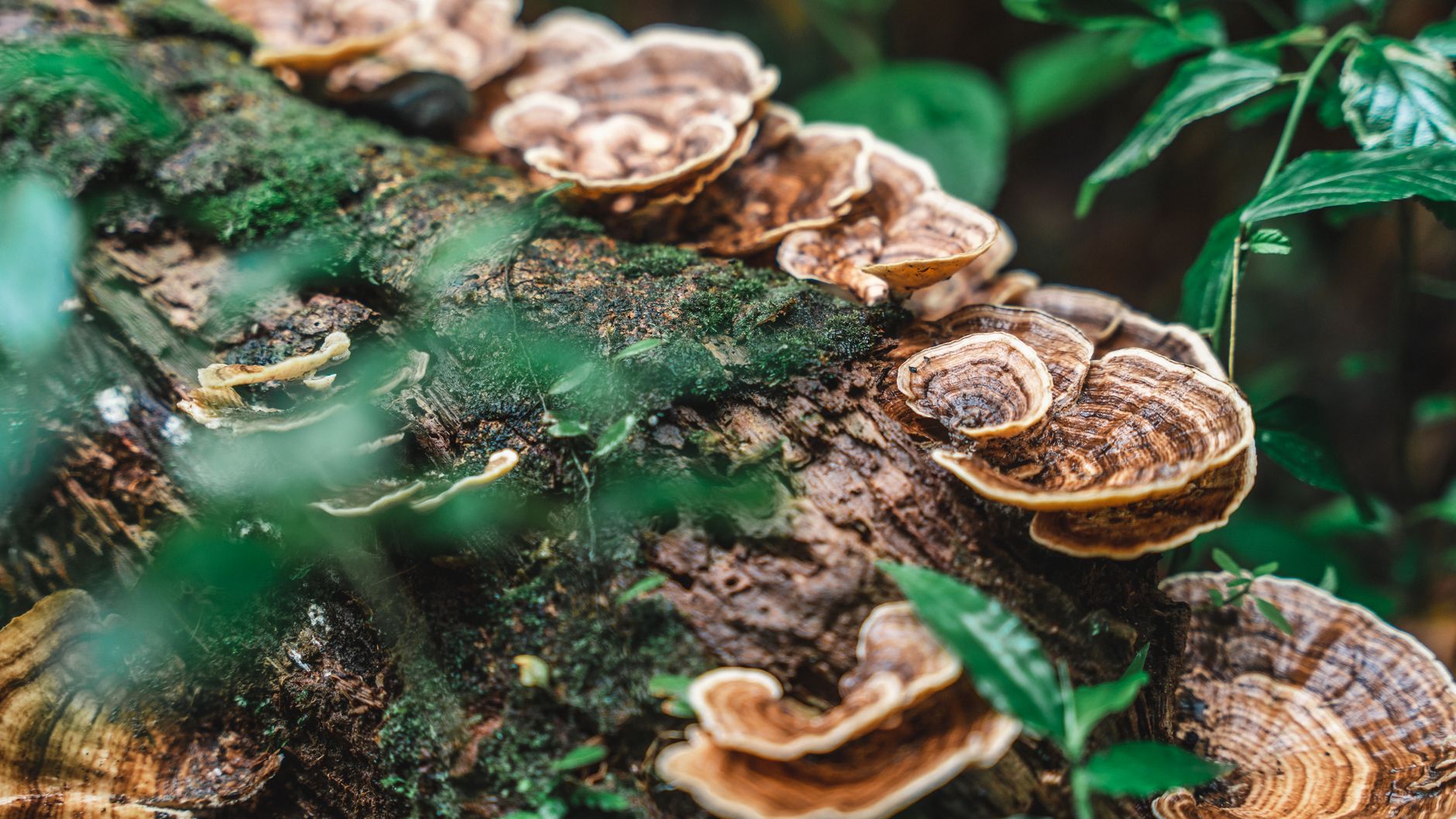
Reishi is a woody, shelf-like polypore mushroom found on the stumps and roots of hardwood trees. In traditional Chinese medicine, it is referred to as lingzhi and has historically been associated with longevity and vitality. Turkey tail, named for the concentric, multi-colored bands on its fan-shaped fruiting body, grows widely on decaying wood across temperate forests globally. Scientifically, it is also known as Coriolus versicolor, a name used frequently in older research literature.
Both belong to the Polyporales order and produce a range of bioactive polysaccharides and secondary metabolites, though the specific compounds and their concentrations differ considerably between species.
Primary Bioactive Compounds
Reishi: Polysaccharides and Triterpenoids
Reishi is notable for containing two major classes of bioactive compounds: beta-glucan polysaccharides and triterpenoids (particularly ganoderic acids). The polysaccharides, especially beta-1,3 and beta-1,6 D-glucans, are the most studied for immune modulation. The triterpenoid fraction has attracted attention for its potential anti-inflammatory and hepatoprotective properties. A 2026 review in Phytotherapy Research summarized that reishi’s biological activities span immunomodulation, anti-inflammatory responses, antioxidant defense, and hepatoprotection, with growing interest in its role in nutraceuticals and functional foods.[1]
Turkey Tail: PSK, PSP, and Structural Polysaccharides
Turkey tail is best known for two polysaccharide-based compounds: polysaccharide K (PSK, also called krestin) and polysaccharide peptide (PSP). PSK has been the subject of extensive clinical investigation in Japan and is used as an approved adjunct in oncology settings in some countries. PSP, found primarily in Chinese-origin strains, has been studied for its effects on T-cell signaling. A 2026 study in the International Journal of Molecular Sciences examined how PSP modulates antiviral signaling networks in CD4+ T cells in a time- and dose-dependent manner, finding upregulation of TLR4, PKR, and interferon-gamma pathways without cytotoxicity at tested concentrations.[2]
Immune Function: Where the Research Stands
Reishi and Immune Cell Modulation
A randomized, double-blind, placebo-controlled clinical trial published in Foods (2023) enrolled healthy adult volunteers who received Reishi beta-1,3/1,6 D-glucan daily for 84 days. Researchers observed statistically significant increases in CD3+, CD4+, and CD8+ T-lymphocyte counts, an improved CD4/CD8 ratio, and elevated natural killer (NK) cell counts and cytotoxicity in the intervention group compared to placebo. Serum immunoglobulin A levels also showed a statistically significant difference. The intervention was reported as safe and well tolerated, with no significant changes in renal or liver function markers.[3]
Turkey Tail and Macrophage Polarization
A 2024 study in the International Journal of Biological Macromolecules isolated a novel polysaccharide (CVPW-1) from Coriolus versicolor and found that it may polarize M2 macrophages toward an M1 phenotype via TLR4-mediated activation of Akt, JNK, and NF-kB signaling pathways. In preclinical models, this process was associated with reversal of CD8+ T-cell inhibition in the tumor microenvironment. The authors noted that oral administration showed effects in vivo, though the transition from preclinical findings to human clinical outcomes requires further investigation.[4]
Clinical Research Depth: A Key Distinction
One of the most meaningful differences between these two species is the depth of clinical evidence. Turkey tail, specifically its PSK fraction, has been studied in human oncology trials over several decades, particularly in Japan, where it has been used alongside conventional cancer treatments. Reishi has also accumulated a substantial human research base, though the focus tends to span broader domains including immune modulation, metabolic health, and sleep quality, rather than concentrating heavily in oncology.
A 2026 review in Molecules covering multiple medicinal mushroom species noted that both Ganoderma lucidum and Trametes versicolor are among the most widely studied species, with experimental and clinical studies indicating that their extracts may support immune function, modulate inflammatory responses, and exhibit antioxidant properties.[5]
Beyond Immunity: Diverging Research Pathways
Reishi’s Broader Research Footprint
Reishi has been studied for a wider range of outcomes beyond immune support. Research has explored its potential effects on sleep latency, stress biomarkers, liver enzyme activity, blood glucose modulation, and lipid profiles. The ganoderic acid fraction in particular has been a focus of anti-inflammatory and hepatoprotective research. For a closer look at what studies show regarding reishi’s effects on liver health, see Reishi and Liver Health: What the Research Shows About Hepatoprotective Compounds.
Turkey Tail’s Microbiome Connections
Research suggests turkey tail’s prebiotic-like polysaccharides may influence gut microbiota composition. Some studies indicate shifts in Lactobacillus and Bifidobacterium populations following supplementation, which may have downstream effects on mucosal immunity. This gut-immune axis is an active area of investigation that distinguishes turkey tail from reishi in terms of mechanism.
Safety Profile and Supplement Considerations
Both mushrooms have generally favorable safety profiles in published studies. Reishi has been associated with occasional gastrointestinal discomfort in sensitive individuals, particularly at higher doses, and there are potential interactions with anticoagulant medications due to platelet-modifying activity. Turkey tail is generally well tolerated, with the RCT literature reporting minimal adverse events at studied doses. Individuals taking immunosuppressant medications should consult a healthcare provider before using either mushroom supplement, as immune-modulating effects could theoretically interfere with drug action.
Supplement quality varies significantly across both categories. Hot-water extraction is typically required to yield bioavailable beta-glucans from the chitin-bound cell walls, and dual-extract products may also capture triterpenoids from reishi. Beta-glucan content verification through third-party testing remains an important consideration when evaluating products.
Which Mushroom Fits Which Goal?
Choosing between reishi and turkey tail depends on the specific health context. Turkey tail’s polysaccharide research is arguably more concentrated in immune-specific and oncology-adjacent applications, particularly the PSK literature. Reishi’s research base is broader, spanning immune function, sleep, liver health, and stress-related outcomes, with human RCT data now available for its beta-glucan fraction. For those interested in a multi-mechanism approach, the two are not mutually exclusive and are commonly found together in multi-mushroom formulations.
Neither mushroom should be viewed as a replacement for conventional medical care. Research suggests both may support certain aspects of immune function and related health outcomes, but the clinical evidence for most specific indications remains in early stages compared to pharmaceutical interventions.
References
- [1] Mohamed G, et al. Unlocking the Therapeutic Potential of Ganoderma lucidum: From Bioactive Compounds to Clinical Translation. Phytotherapy Research. 2026. PMID: 42116536
- [2] Rosario-Sanfiorenzo GN, et al. Time- and Dose-Dependent PSP-Induced Modulation of Antiviral Signaling Networks in CD4+ T Cells. Int J Mol Sci. 2026. PMID: 42074298
- [3] Chen SN, et al. Evaluation of Immune Modulation by beta-1,3; 1,6 D-Glucan Derived from Ganoderma lucidum in Healthy Adult Volunteers, A Randomized Controlled Trial. Foods. 2023. PMID: 36766186
- [4] Bi S, et al. A novel polysaccharide isolated from Coriolus versicolor polarizes M2 macrophages into an M1 phenotype. Int J Biol Macromol. 2024. PMID: 38218293
- [5] Sadowska A, et al. Medicinal Mushrooms and Their Bioactive Compounds: From Traditional Use to Therapeutic Potential. Molecules. 2026. PMID: 42197308
Disclaimer: This article is for informational purposes only and does not constitute medical advice. The statements on this page have not been evaluated by the Food and Drug Administration. Functional mushroom supplements are not intended to diagnose, treat, cure, or prevent any disease. Consult a qualified healthcare provider before starting any new supplement regimen.