Walk into any health food store or scroll through a supplement retailer online and you will find dozens of functional mushroom products competing for your attention. The labels are dense with percentages, compound names, and marketing language that can be difficult to interpret. Understanding what those numbers actually represent is essential for making an informed purchasing decision.
The Core Compounds: What You Are Actually Measuring
Two terms appear on nearly every functional mushroom supplement label: polysaccharides and beta-glucans. While they are related, they are not interchangeable, and the distinction matters when evaluating product quality.
Polysaccharides are a broad class of complex carbohydrates made up of long chains of sugar molecules. Mushrooms contain many types of polysaccharides, and not all of them have demonstrated biological activity in humans. Beta-glucans are a specific subset of polysaccharides characterized by glucose units linked in a particular arrangement. Research suggests that beta-glucans, especially those with a (1,3)/(1,6) linkage pattern, are responsible for much of the immunomodulatory activity attributed to functional mushrooms.[1]
A product listing 40% polysaccharides is not necessarily more potent than one listing 20% beta-glucans. If anything, a verified beta-glucan percentage is generally considered the more meaningful figure because it reflects a more precisely defined bioactive fraction. For a deeper look at how these two values are calculated and reported differently, see our article on the difference between beta-glucan content and polysaccharide content on labels.
Fruiting Body vs. Mycelium on Grain
One of the most consequential pieces of information on a mushroom supplement label is the source of the mushroom material. Labels typically list one of three things: fruiting body, mycelium, or mycelium on grain (sometimes called myceliated grain or fermented grain substrate).
Fruiting Body
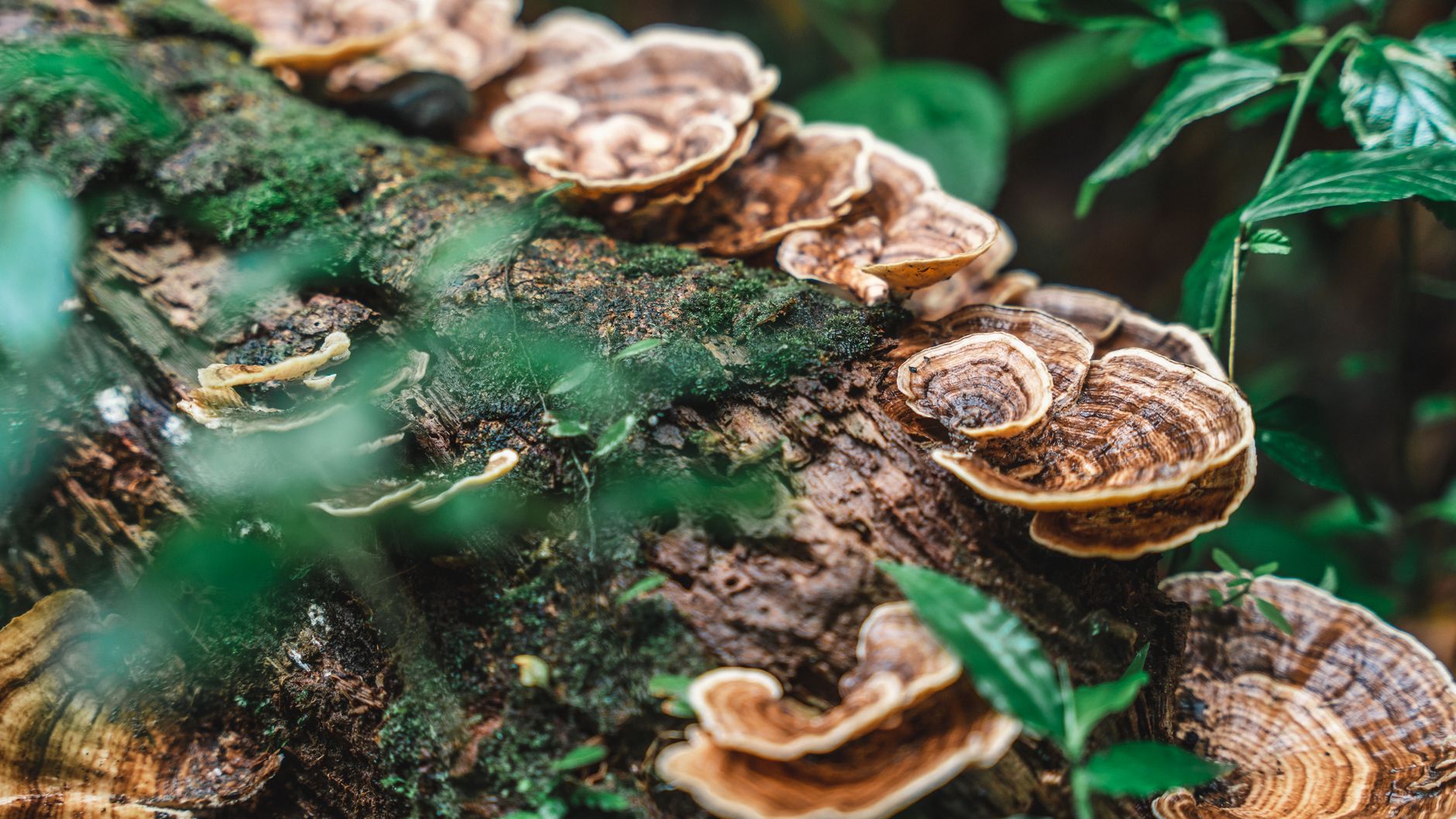
The fruiting body is the above-ground structure we recognize as the mushroom. This is the part of the organism that has been used in traditional medicine for centuries, and it is where concentrations of beta-glucans and triterpenoids are typically highest. Studies that test the immunomodulatory effects of mushroom compounds almost universally use fruiting body material or extracts derived from it.
Mycelium on Grain
Mycelium is the root-like network of fungal threads that grows through a substrate. In commercial production, this substrate is often brown rice or oats. When the product is harvested and dried before the substrate is separated, the resulting powder contains significant amounts of starch from the grain itself. Research indicates that these myceliated grain products can differ substantially in their composition from fruiting body extracts, with some containing little to no detectable beta-glucans from the mushroom itself and high starch content instead.[2] An iodine-starch test can reveal the presence of residual grain starch and may serve as one quality marker when evaluating supplement composition.
Extraction Methods and What They Produce
Raw mushroom powder and mushroom extract are not the same thing, and a label that does not specify extraction method may not be delivering bioavailable compounds. The cell walls of mushrooms are composed largely of chitin, which the human digestive system cannot readily break down. To make the bioactive compounds accessible, the material typically needs to be processed.
Hot Water Extraction
Hot water extraction is the most common method for releasing polysaccharides and beta-glucans from mushroom material. Research on beta-glucan solubilization in Ganoderma species suggests that immunostimulating beta-glucans are most effectively recovered in hot water fractions, making this extraction method particularly relevant for immune-focused applications.[3] A label that reads “hot water extract” or “aqueous extract” indicates this process was used.
Dual Extraction
Some mushrooms, particularly Reishi and Chaga, contain both water-soluble compounds (beta-glucans, polysaccharides) and alcohol-soluble compounds (triterpenoids). Dual extraction uses both water and ethanol in sequence to capture a broader spectrum of bioactive constituents. If triterpenoid content is important to you for a particular species, look for a label that specifies dual extraction or lists triterpenoid content separately.
Raw Powder
Products labeled simply as “mushroom powder” without mentioning extraction have likely not undergone a process to break down the chitin cell walls. Research has noted that variables including extraction method, growing conditions, and mushroom strain all influence the measurable biological activity of a given preparation, and that these inconsistencies make cross-product comparisons difficult.[1] Raw powders are not inherently without value, but the bioavailability of their active compounds may be lower than that of extracts.
Extract Ratios and What They Indicate
You may see a product labeled as a “10:1 extract” or similar ratio. This indicates how much raw material was used to produce a given amount of final extract. A 10:1 ratio means ten grams of raw mushroom were used to produce one gram of extract. While this suggests concentration, it does not guarantee a higher beta-glucan percentage or greater efficacy. A ratio alone is not a sufficient quality indicator without accompanying third-party beta-glucan testing results.
Third-Party Testing and Certificates of Analysis
Reputable manufacturers will provide a Certificate of Analysis (COA) from an independent laboratory. This document verifies the beta-glucan percentage, confirms the absence of heavy metals, pesticides, and microbial contaminants, and establishes that the product matches what the label claims. If a company does not make its COA available on request, that absence is worth noting. Research on supplement quality for categories like Chaga has found that some commercially available products contain compositions that differ substantially from what their labels imply, underscoring the importance of verified third-party analysis.[2]
A Practical Label-Reading Checklist
When evaluating a functional mushroom supplement, consider the following:
- Source material: Does the label specify fruiting body, mycelium, or myceliated grain? Fruiting body extract is generally the better-studied option.
- Beta-glucan percentage: Is this listed and verified? A tested beta-glucan figure is more informative than a polysaccharide percentage alone.
- Extraction method: Is hot water, dual, or another extraction method specified?
- Starch content: Some certificates of analysis report starch; high starch may indicate grain filler in myceliated products.
- Third-party COA: Is independent lab verification available?
- Species and part used: The label should name the species in full (e.g., Ganoderma lucidum) and indicate which part of the organism was used.
No label can guarantee clinical outcomes, and product research in functional mushrooms is still developing. However, understanding the information a label does and does not convey puts you in a better position to compare products and ask the right questions before purchasing.
References
- 1. Motta F, Gershwin ME, Selmi C. Mushrooms and immunity. J Autoimmun. 2021;117:102576. PMID: 33276307
- 2. Windsor C, et al. Comparative Study of Chaga (Inonotus obliquus) Dietary Supplements Using Complementary Analytical Techniques. Int J Mol Sci. 2025;26(7):2970. PMID: 40243601
- 3. Ishimoto Y, et al. Enhanced Release of Immunostimulating beta-1,3-Glucan by Autodigestion of the Lingzhi Medicinal Mushroom, Ganoderma lingzhi. Int J Med Mushrooms. 2017;19(1):1-16. PMID: 28322142
Disclaimer: This article is for informational purposes only and does not constitute medical advice. Functional mushroom supplements are not intended to diagnose, treat, cure, or prevent any disease. Consult a qualified healthcare provider before beginning any new supplement regimen.