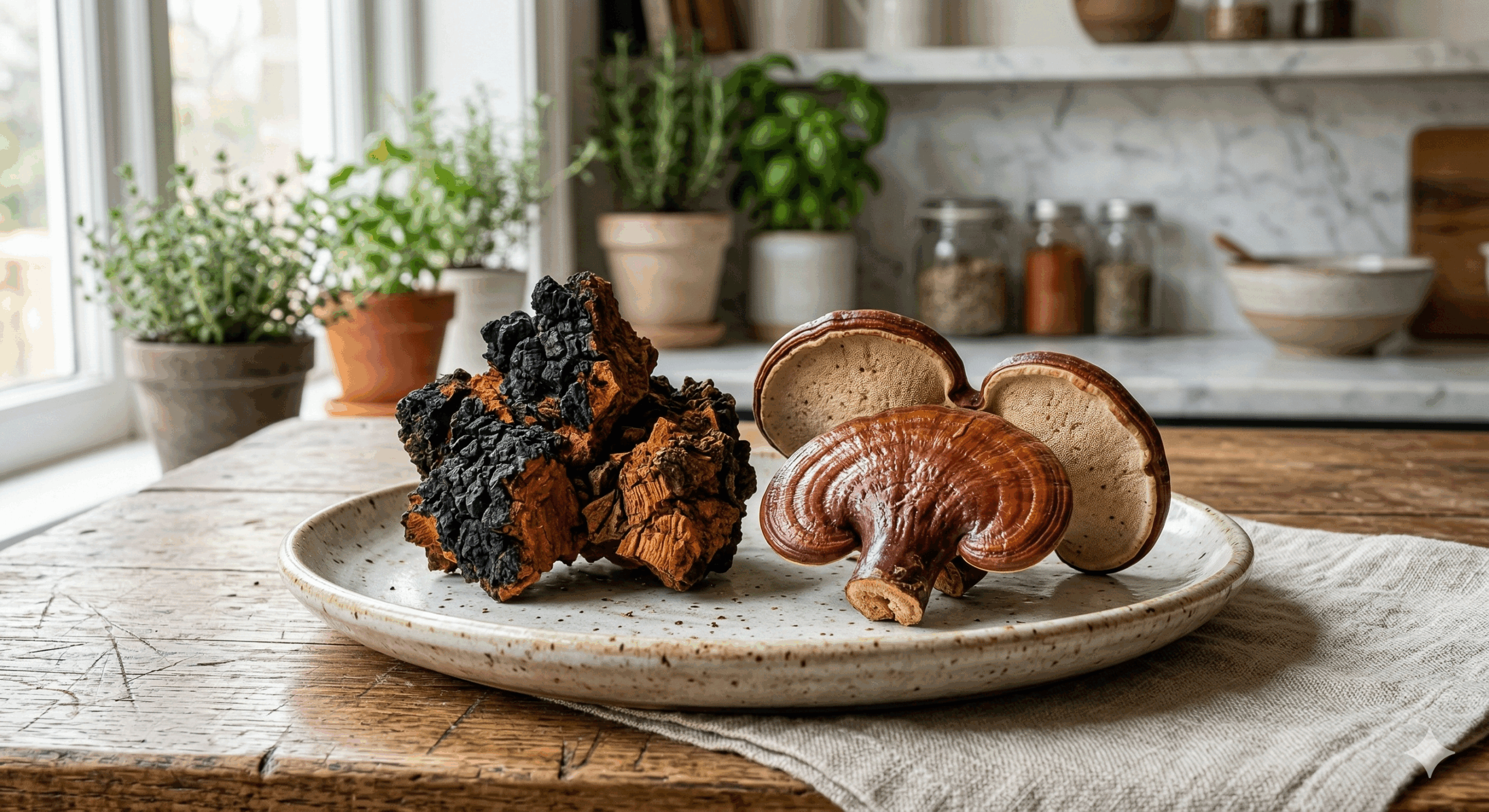
Walk into any health food store and you’ll find a wall of mushroom supplements — each one promising something different. Chaga for immunity. Reishi for stress. But if your goal is supporting your immune system, which one actually deserves a spot in your daily routine?
Both are legitimate. Both have real research behind them. But they work differently, and knowing the distinction helps you make a smarter choice. If you’re new to functional mushrooms entirely, start with our guide to adaptogens and mushrooms before diving in here.
What Is Chaga?
Chaga (Inonotus obliquus) grows primarily on birch trees in cold northern climates — Siberia, Canada, Scandinavia. It looks more like a chunk of charred wood than a mushroom, but inside that rough exterior is a dense concentration of beta-glucans, betulinic acid, and antioxidants.
Chaga has one of the highest ORAC (antioxidant capacity) scores of any food ever measured. The primary immune benefit comes from its beta-glucan content, which activates and modulates white blood cell response — essentially helping your immune system stay alert without going into overdrive. For a deeper look at what makes Chaga special, see our piece on Chaga and its antioxidant properties.
What Is Reishi?
Reishi (Ganoderma lucidum) has been used in traditional Chinese and Japanese medicine for over 2,000 years. It’s often called the “mushroom of immortality” — which is marketing-adjacent, but the underlying research is genuinely solid.
Reishi’s key compounds are triterpenes (specifically ganoderic acids) and beta-glucans. Where Chaga leans more antioxidant-heavy, Reishi is particularly well-studied for immune modulation — meaning it helps regulate immune response rather than just stimulate it. This makes it especially useful for people dealing with chronic stress, inflammation, or immune systems that are overactive rather than underactive. We break this down further in our full Reishi benefits guide.
Head-to-Head: Immune Support
Raw Immune Activation
Chaga edges ahead here. Its beta-glucan density and antioxidant load make it a strong choice for people who want broad immune stimulation and oxidative stress protection — especially during cold and flu season.
Immune Regulation & Inflammation
Reishi wins this one. Its triterpenes have demonstrated anti-inflammatory effects in multiple studies, and its adaptogenic properties make it better suited for immune systems stressed by poor sleep, high cortisol, or chronic illness. Read more on Reishi specifically for immune support.
Gut-Immune Connection
Reishi again. Research has shown Reishi positively shifts the gut microbiome composition, which has downstream effects on immune function given that roughly 70% of immune activity is gut-associated.
Can You Take Both?
Yes — and many people do. Chaga and Reishi are complementary rather than redundant. A common approach is Chaga in the morning for its energizing antioxidant properties and Reishi in the evening for its calming, immune-regulating effects. For more on building a complete daily stack, see our guide to daily mushroom routines.
If you’re considering combining mushrooms with other supplements, also check out mushrooms and nootropics for compatibility guidance.
Which Should You Start With?
- Choose Chaga if: You want strong antioxidant support, you’re prone to seasonal illness, or you’re generally healthy and looking for broad immune maintenance.
- Choose Reishi if: You deal with chronic stress, inflammation, poor sleep, or you want an adaptogen that supports immune balance rather than stimulation.
- Take both if: You want comprehensive immune coverage and are ready to build a real mushroom stack.
Either way, sourcing matters. Look for dual-extraction products that process both water-soluble beta-glucans and alcohol-soluble triterpenes — you need both to get the full benefit. The NIH has published peer-reviewed research on both mushrooms confirming their immunomodulatory properties. For a convenient format, mushroom gummies have come a long way and are worth considering for daily use.