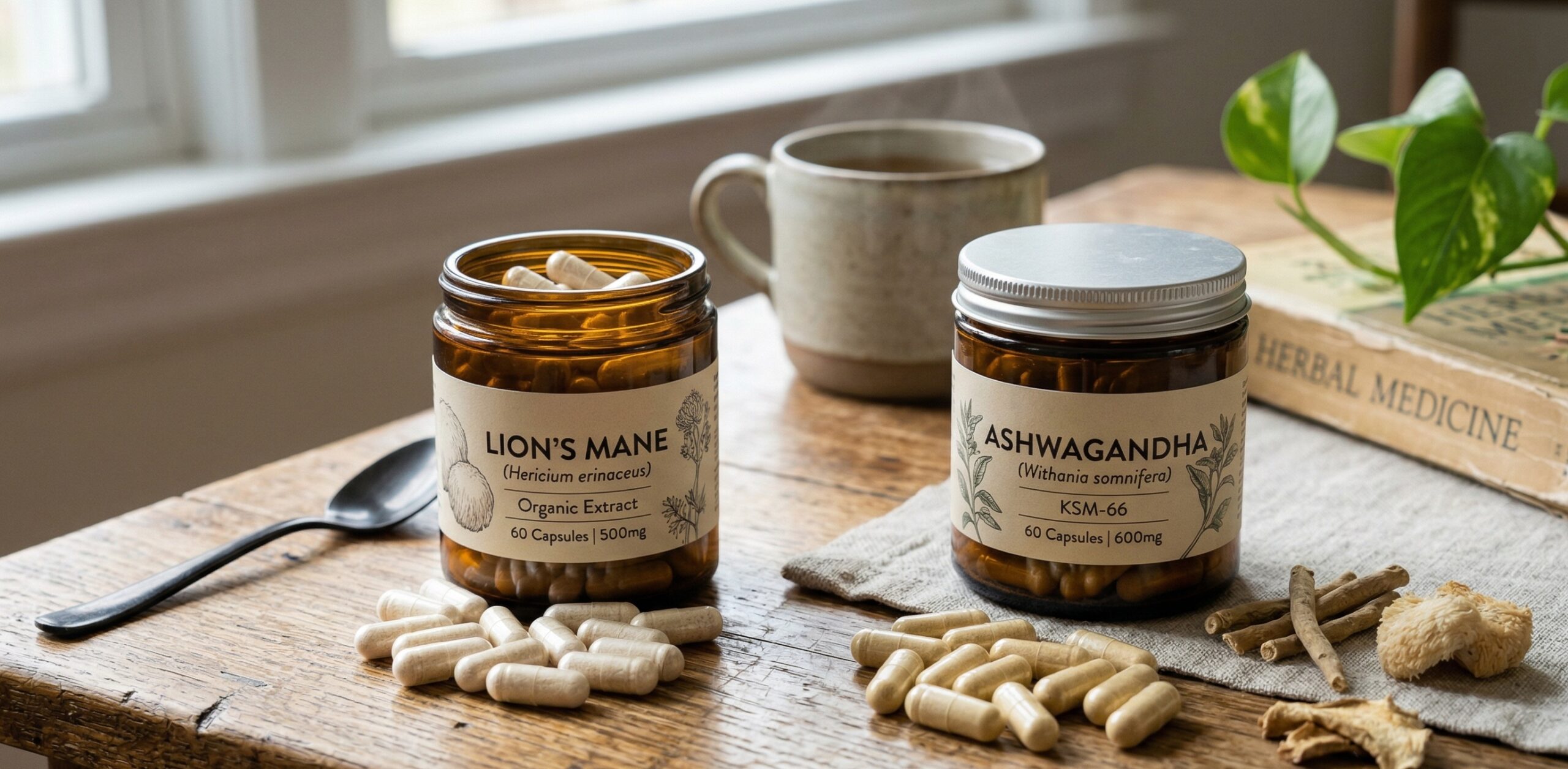
Two of the most popular natural wellness supplements on the market today are Lion’s Mane mushroom and ashwagandha root. Both are frequently labeled as “adaptogens” — substances that help the body adapt to stress — and both have legitimate science behind them. But they’re actually quite different in how they work and what they’re best suited for. If you’re trying to decide between the two (or figure out if you should take both), this guide will break it all down.
What Is Lion’s Mane Mushroom?
Lion’s Mane (Hericium erinaceus) is a striking white, shaggy mushroom that looks remarkably like a lion’s mane — hence the name. It’s been used in East Asian traditional medicine for centuries, particularly for digestive and cognitive support. Modern research has focused primarily on its ability to stimulate Nerve Growth Factor (NGF) and Brain-Derived Neurotrophic Factor (BDNF), two proteins critical for the growth, maintenance, and survival of neurons.
This makes Lion’s Mane unique among functional mushrooms: it’s less of a traditional adaptogen and more of a nootropic and neuroregeneration support compound. For more on how Lion’s Mane affects the brain, see our in-depth post on Lion’s Mane for Cognitive Support.
What Is Ashwagandha?
Ashwagandha (Withania somnifera) is an ancient Ayurvedic herb with a centuries-long history of use as a “rasayana” — a rejuvenating tonic. Its primary active compounds are withanolides, which are steroidal lactones with anti-inflammatory and adaptogenic effects. Unlike Lion’s Mane, ashwagandha is a true, classical adaptogen: its primary mechanism is modulating the HPA axis (hypothalamic-pituitary-adrenal axis), which governs your cortisol stress response.
Key Differences: Lion’s Mane vs. Ashwagandha
Primary Mechanism
- Lion’s Mane: Stimulates NGF and BDNF; supports neuroplasticity, myelination, and neuronal repair
- Ashwagandha: Modulates cortisol and the HPA stress axis; reduces stress hormone output
Cognitive Effects
- Lion’s Mane: Stronger evidence for memory, focus, and long-term cognitive protection. A double-blind trial in Phytotherapy Research found significant improvements in cognitive scores in older adults with mild cognitive impairment after 16 weeks of Lion’s Mane supplementation.
- Ashwagandha: Also improves memory and cognitive performance, but primarily through reducing stress and cortisol — which indirectly clears cognitive fog. Not a direct neuroregeneration agent.
Stress and Anxiety
- Lion’s Mane: Some evidence for reducing anxiety and depressive symptoms, particularly through NGF’s role in emotional regulation. One small Japanese study found reduced depression and anxiety in postmenopausal women who ate Lion’s Mane cookies for four weeks. [source]
- Ashwagandha: This is its strongest suit. Multiple randomized controlled trials have shown ashwagandha reduces perceived stress, anxiety scores, and cortisol levels significantly compared to placebo. [source] It is among the more well-researched herbal options for stress and anxiety reduction.
Sleep Quality
- Lion’s Mane: Some users report improved sleep, likely related to reduced anxiety and improved nervous system health.
- Ashwagandha: Strong evidence. A study published in PLOS ONE found ashwagandha root extract significantly improved sleep quality, sleep onset latency, and total sleep time.
Physical Performance
- Lion’s Mane: Limited direct evidence for athletic performance.
- Ashwagandha: Well-documented benefits for muscle strength, recovery, VO2 max, and testosterone levels. Multiple studies in athletes support its use as a performance-enhancing adaptogen.
Gut Health
- Lion’s Mane: Significant evidence for gastrointestinal health, including protection against ulcers and potential benefits for the gut-brain axis.
- Ashwagandha: Less direct gut research, though its anti-inflammatory properties may benefit the gut indirectly.
Side Effects and Safety
Both supplements are generally considered safe for most healthy adults when taken at appropriate doses. However:
- Lion’s Mane: Rarely causes side effects. Some individuals report mild digestive discomfort initially. Allergy is possible but uncommon. Avoid if you have mushroom allergies.
- Ashwagandha: Can cause digestive upset in some people. Not recommended during pregnancy (may stimulate uterine contractions). Rare cases of liver injury have been reported at high doses. May interact with thyroid medications and immunosuppressants. Those with thyroid conditions should consult a doctor first, as ashwagandha can affect thyroid hormone levels.
Who Should Take Lion’s Mane?
Lion’s Mane is the better choice if you are primarily looking to:
- Improve focus, memory, and cognitive clarity
- Support long-term brain health and neurological protection
- Recover from brain fog, concussion, or neurological stress
- Support a healthy gut-brain axis
- Address mild anxiety or low mood in the context of cognitive decline
It’s particularly appealing for knowledge workers, students, and anyone concerned about age-related cognitive decline.
Who Should Take Ashwagandha?
Ashwagandha is the better choice if you are primarily looking to:
- Reduce chronic stress and anxiety
- Improve sleep quality
- Boost testosterone, muscle strength, and physical performance
- Reduce cortisol and adrenal fatigue
- Improve energy and vitality through hormonal balance
It’s particularly well-suited for those dealing with high stress loads, athletic recovery goals, or hormonal imbalances driven by chronic stress.
Can You Take Lion’s Mane and Ashwagandha Together?
Yes — and in fact, many people take both. They work through entirely different mechanisms and complement each other well:
- Ashwagandha reduces the hormonal effects of stress (cortisol, adrenaline), which creates a better physiological environment for Lion’s Mane’s neuroregeneration effects to take hold.
- Lion’s Mane supports the nervous system architecture that ashwagandha helps regulate.
Together, they form a powerful cognitive and stress resilience stack. For more on combining functional mushrooms with other supplements, see our guide on Combining Mushrooms with Nootropics.
Dosage Guidelines
Lion’s Mane
- A 2019 study in Phytotherapy Research used hot water and alcohol dual-extracted Lion’s Mane in their supplementation protocol — researchers recommend looking for standardized extracts with a verified beta-glucan and hericenone content
- Best taken in the morning or early afternoon
- Effects on cognition may take 4-8 weeks to become fully apparent
Ashwagandha
- Research trials have most commonly used KSM-66 and Sensoril — two standardized ashwagandha extracts; the dosages used in these studies were determined by the researchers and should be confirmed with a healthcare provider before use
- Can be taken morning or evening (evening preferred if primarily for sleep)
- Stress and anxiety benefits often felt within 2-4 weeks
The Verdict
There’s no single winner here — it comes down to your goals:
- For brain power and neuroprotection: Choose Lion’s Mane
- For stress, sleep, and physical performance: Choose Ashwagandha
- For comprehensive mental and physical resilience: Consider both
At SafeShrooms, we believe in transparency and evidence-based supplementation. Whether you’re exploring Lion’s Mane, ashwagandha, or a complete functional mushroom stack, we’re here to help you find what works. Visit our contact page to speak with our team, or explore our full range of functional mushrooms explained to learn more.